Fintech on File #3 | Mastercard buys BNVK, Tempo launches, OpenAI pulls back Instant Checkout
March 22, 2026

This week’s edition continues the stablecoin/blockchain theme from the prior Fintech on File with Mastercard announcing its acquisition of BVNK, Tempo launching its L1 blockchain, and Figure unveiling Forge to increase the liquidity of tokenized assets.
Deal Room
Mastercard Acquires BVNK for Up to $1.8B | Mastercard
Mastercard announced a definitive agreement to acquire BVNK, a London-based stablecoin infrastructure company, for up to $1.8B (including $300M in contingent payments). This is the largest stablecoin acquisition to date, eclipsing Stripe’s $1.1B purchase of Bridge last year. Coinbase nearly bought BVNK for ~$2B before those talks collapsed around November. Mastercard had also been in discussions with Zerohash for $1.5–$2B, and that fell through too.
BVNK processes roughly $30B in annual stablecoin payments across 130+ countries on all major blockchain networks. BVNK reportedly only generates ~$40M in revenue[1] – valuing the company at 45x revenue. The deal rationale is less about current financials than the technical capabilities BVNK provides, including giving Mastercard the ability to plug 24/7 stablecoin settlement directly into its existing payment rails — think cross-border transfers, B2B payments, and remittances.
As Jorn Lambert, MA’s Chief Product Officer, put it: most financial institutions and fintechs will eventually provide digital currency services, whether via stablecoins or tokenized deposits. Mastercard wants to maintain its current positioning in card-based payments as the orchestration layer, whether fiat or stablecoins. This acquisition provides Mastercard with the technical capabilities to offer fiat-to-stablecoins on/off-ramps. Combine this with the Crypto Partner Program launch the week prior (85+ companies) and it’s clear Mastercard is willing to invest significant capital to position it favorably as stablecoins further integrate into traditional payments.
Kraken IPO Frozen | CoinDesk
Kraken has shelved its multibillion-dollar IPO, just four months after confidentially filing with the SEC and closing an $800M round at a $20B valuation (including $200M from Citadel Securities). The exchange is reportedly waiting for market conditions to stabilize before revisiting a listing. BitGo, the only digital asset company to list this year, has seen its stock drop 44% from its offering price. For context, 2025 saw 11 crypto IPOs raise a combined $14.6B, including several digital asset treasury companies (DATs). The Kraken IPO would’ve been a marquee listing for blockchain financial infrastructure, with the market structure bill nearing passage. We’ll see if this is a short-term delay or a longer shelving. Not everyone is pulling back — Securitize is still pushing ahead with its SPAC, including a $225M PIPE.
Fintech In The News
Tempo Launches Mainnet and Machine Payments Protocol | CoinDesk
Tempo, the payments-focused blockchain incubated by Stripe and Paradigm, launched its mainnet along with the Machine Payments Protocol (MPP), an open standard co-authored with Stripe that enables AI agents to pay for services autonomously. Visa contributed card-based payment specs to the protocol as well. Tempo raised $500M at a $5B valuation in 2025 from investors including Thrive Capital.
MPP is payment-method agnostic — it supports stablecoins on Tempo, Stripe-powered card payments, and other rails. An agent can request a resource, the service responds with a payment request, the agent authorizes from its wallet, settlement is instant, and the resource is delivered. The “sessions” feature allows pre-authorized spending limits with streaming micro-payments batched for efficiency.
The competitive landscape for agentic payments protocols is crowded, Coinbase’s x402, Google releasing its own scheme in September (supporting cards + stablecoins), and the Ethereum Foundation backed ERC-8004. But Tempo/Stripe’s advantage is distribution — Stripe already processes payments for millions of merchants. If MPP becomes the default protocol, Stripe’s install base will play a pivotal role.
OpenAI Rolls Back Instant Checkout | Wired
OpenAI is phasing out its Instant Checkout feature and moving to a merchant-controlled app model within ChatGPT. Walmart revealed that conversion rates for purchases completed directly inside ChatGPT were 3x lower than products that clicked out to Walmart’s own site. Only about 30 Shopify merchants and ~200K Walmart products ever went live. OpenAI hadn’t built systems for sales tax collection or fraud prevention. The word “unsatisfying” was used by a Walmart EVP.
I’m in the camp that OpenAI, Anthropic, and Google will all figure out native-LLM commerce over time — the data advantage and consumer intent signals are too powerful to ignore. But this episode shows the importance of focus. Doing e-commerce well is hard even if you own the top of the funnel. OpenAI learned the same lesson as every marketplace before it: the last mile of commerce is brutally difficult.
Walmart is now embedding its own Sparky chatbot directly into ChatGPT (and soon Gemini), keeping full control of the shopping experience while riding on the distribution of consumer AI apps. Conversion rates for Sparky-through-ChatGPT are reportedly running at ~70% of Walmart.com direct — far better than Instant Checkout’s numbers. Imagine telling someone back when OpenAI announced Instant Checkout that things would be going so poorly that they would end up letting Walmart’s Sparky into their checkout flow.
CFTC Issues No-Action Letter for Phantom | CFTC
The CFTC’s Market Participants Division issued a no-action position to Phantom Technologies, the self-custodial crypto wallet provider. The letter states that MPD will not recommend enforcement action against Phantom for failure to register as an introducing broker, provided Phantom meets certain conditions around its software that facilitates user trading with registered FCMs, introducing brokers, and designated contract markets.
An important clarification: this is a no-action letter, not a formal ruling or regulation. The CFTC is saying it won’t pursue Phantom under current law, not that it’s establishing a new policy. That said, the significance for the self-custodial wallet ecosystem is real. This provides a workable framework for wallet providers to enable derivatives trading access without triggering broker registration requirements — a practical on-ramp for DeFi-to-CeFi interoperability that the industry has been navigating cautiously.
Figure Launches Forge | Figure Chairman Mike Cagney’s X @mcagney
Figure (Nasdaq: FIGR) launched Figure Forge, a tokenization service for real-world assets running on the Provenance blockchain. The service converts illiquid assets — real estate equity, auto loans, equipment financing — into fungible digital tokens that can be used as collateral in decentralized finance (DeFi) protocols. The first application is a partnership with Agora Data to tokenize auto loan portfolios originated through independent car dealers.
Figure has been quietly building one of the more interesting onchain financial infrastructure stacks in the market. Between Figure Connect, FGRD (the first public equity security fully issued, traded, and settled on-chain), the OPEN network, and now Forge, Figure is assembling a vertically integrated blockchain capital markets platform. Forge is the latest piece connecting real-world origination to onchain liquidity.
S&P 500 Goes Onchain via Hyperliquid | S&P Global
S&P Dow Jones Indices licensed the S&P 500 to Trade[XYZ] to launch the first officially approved S&P 500 perpetual futures contract on the Hyperliquid blockchain. Non-U.S. investors can now take leveraged, onchain S&P 500 exposure 24/7 using real-time index data.
This is a landmark for the convergence of traditional finance benchmarks and onchain infrastructure. S&P DJI licensing its flagship index to a decentralized exchange is a strong signal of institutional adoption. The practical implications are continuous price discovery, 24/7 hedging, and global accessibility without the friction of traditional futures exchanges.
Data That Matters
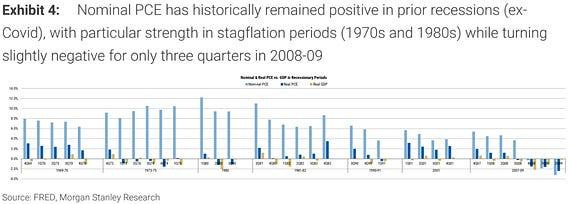
Worth keeping in mind as we enter a more uncertain macro environment: the fundamentals of payments companies tend to be more resilient than investors assume. Payments companies generate most of their revenue from charging a percentage fee on nominal spend, insulating their revenue to some degree from broader macro slowing, especially if nominal and real PCE diverge due to higher inflation. And historically, real PCE tends to hold up relatively well in downturns. Of course, every situation has its nuances and this just focuses on the revenue side of the equation, ignoring the negative impact a downturn would have on valuations. The data below – provided by Morgan Stanley – is meant to illustrate the overall resilience of the payments business model in tough economic times.
[1] CoinDesk